RepoMind
Agentic AI repository analyzer — a multi-agent system for codebase understanding.
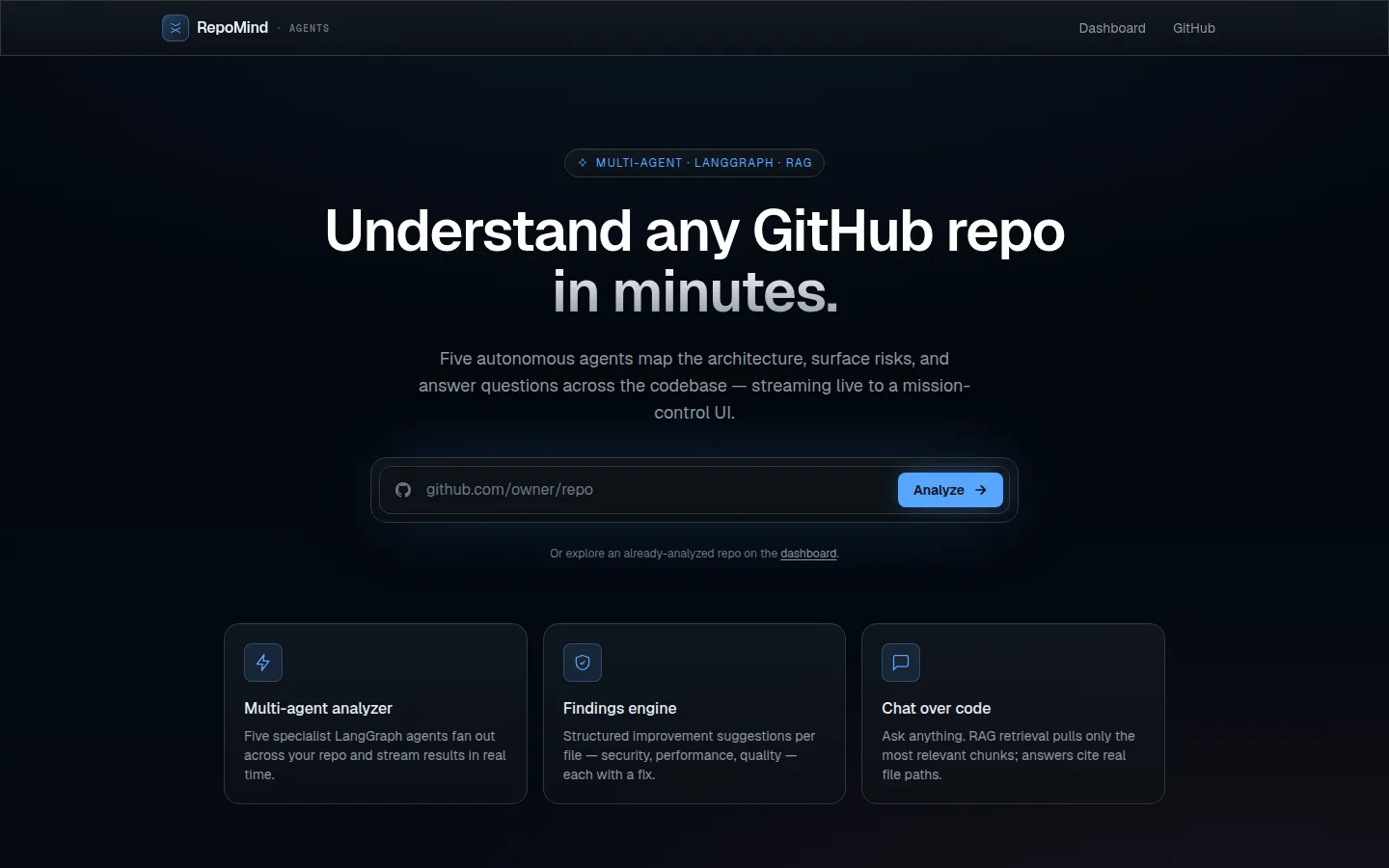
Understanding an unfamiliar repository means reading many files before you can ask a useful question about it.
Every new codebase starts the same way: days of opening file after file just to learn where things live. I wanted to ask a repository a question the way I'd ask a senior teammate — and get an answer that points to real code.
- Q1
Can one model call ever understand a whole repository, or does the work need to be split?
- Q2
How do I keep answers tied to actual files instead of confident guesses?
- Q3
Analysis takes time — how does the user know something is happening?
A multi-agent AI system that autonomously analyzes GitHub repositories — mapping architecture, summarizing modules, and answering code questions.
Several agents instead of one giant prompt
Mapping architecture, summarizing modules and answering questions are different jobs. LangGraph lets each job have its own agent and keeps the hand-offs under control.
Retrieval over code, not the whole repo in context
Source is chunked and embedded into Pinecone, so an agent pulls only the files that matter for a question — answers stay grounded and prompts stay small.
Queue the heavy work, stream the progress
Indexing runs as BullMQ jobs so the API stays responsive, and every agent step streams to the Next.js UI so the wait is visible.
LangChain + LangGraph coordinate the agents that analyze a repository.
OpenAI function calling lets agents invoke tools during analysis.
A retrieval pipeline over source code using Pinecone embeddings grounds answers in the repository.
Redis-backed memory keeps agent state across steps.
- Real-time agent progress is streamed to a Next.js UI.
- Node.js services back the UI, with BullMQ job queues for analysis work.
- Redis provides agent memory; Pinecone stores code embeddings.
Keeping agents coherent across many steps. Each one needs to know what the others already found — that is exactly the job of the Redis-backed memory.
Agentic systems are mostly orchestration and state, not prompts. The model is one component; the queue, the memory and the retrieval layer decide whether it's reliable.