Cueline
A real-time interview copilot: live transcript, question detection and streamed answers grounded in your resume.
- median from end of question to first answer word
- ~2 smedian from end of question to first answer word
- median time to first token (Claude Haiku)
- 747 msmedian time to first token (Claude Haiku)
- layers of question detection
- 4layers of question detection
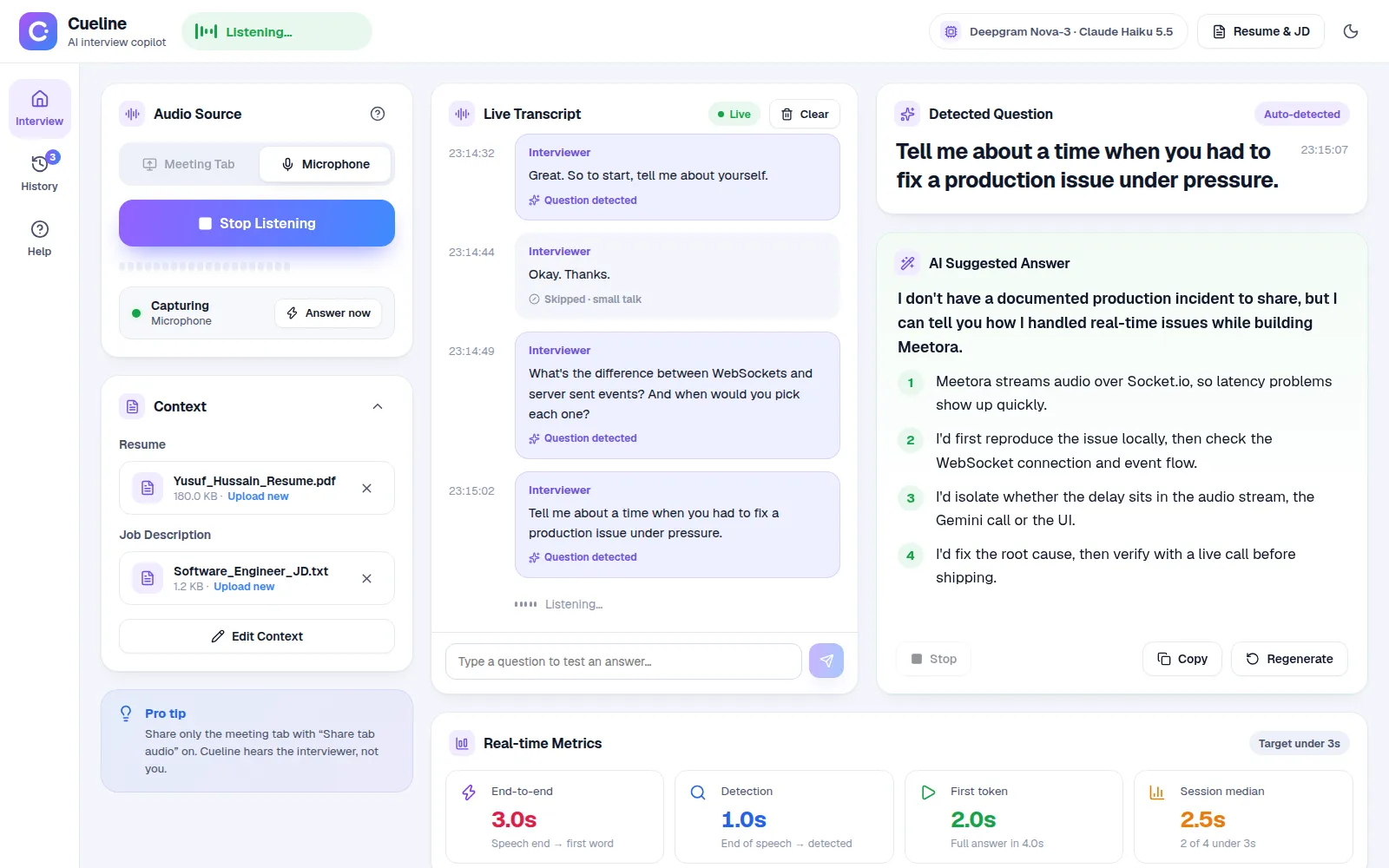
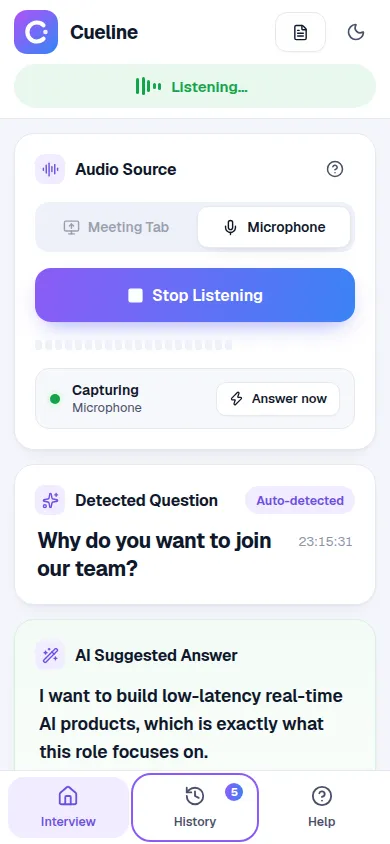
Cueline listens to the interviewer in a Google Meet or Zoom tab, transcribes them live, works out when a real question has been asked, and streams back a short, speakable answer based on your resume and the job description.
In a live interview the answer is only useful in the next two or three seconds. That turns an “AI chat” problem into a real-time systems problem: audio capture, streaming speech-to-text, deciding when a question is finished, and an LLM that starts talking fast enough.
- Q1
When has the interviewer actually asked a question, and not just said “can you hear me?”
- Q2
Which speech-to-text gives live partial results and end-of-speech signals?
- Q3
Which model can start answering inside a 3-second budget?
- Q4
How do I keep every vendor swappable?
Deepgram over raw WebSocket, no SDK
It streams interim and final results and gives end-of-speech signals for free. The protocol is small, so writing it directly keeps every byte visible. An SttStream interface keeps the server provider-neutral.
Measure the model, don't guess
A benchmark script sent five interview questions through the real prompt: Claude Haiku 747 ms median TTFT, GPT-4.1 mini 1,422 ms, Opus (low effort) 5,303 ms. Detection takes ~1.1 s, so only Haiku leaves real headroom. Opus is one env var away.
Detection layers that get more expensive only when needed
Rules on every turn (~0 ms), a short hold when a turn trails off on “and / the / to”, an LLM classifier only when rules can't decide, and a stable-interim backstop when STT is slow to finalise.
One shared WebSocket contract
A shared package holds the message types and audio constants, so client and server can't drift apart.
- Captures tab audio (Chrome/Edge) or the microphone
- AudioWorklet resamples to 16 kHz PCM and streams 50 ms chunks
- Live transcript with interim and final text
- Question detection with rules, hold, classifier and backstop
- Short, speakable answers grounded in resume + job description
- Streamed token by token, with latency metrics in the UI
- Claude, OpenAI, Gemini, Groq or DeepSeek behind one LlmClient interface
- Deepgram behind an SttStream interface
- History of past sessions
Measured on a bundled 71-second mock interview (5 questions): Deepgram endpointing ~1.0–1.4 s, then detection, then first token. Median first word ≈ 2 s.
One Session per socket runs the pipeline and records latency metrics for every answer.
Environment is validated with zod at startup; provider selection is one setting.
Tab audio needs Chrome or Edge; microphone mode has no speaker separation. Next step: speculative generation and a labelled evaluation set.
Answering at the right moment: not on small talk, not halfway through “tell me about a time when…”, and not seconds late. That is why detection is layered instead of one prompt.
Latency is a budget you spend stage by stage. Writing the budget down (endpointing, detection, first token) showed exactly where the next second could come from: speculative generation on stable interim text.