Nova
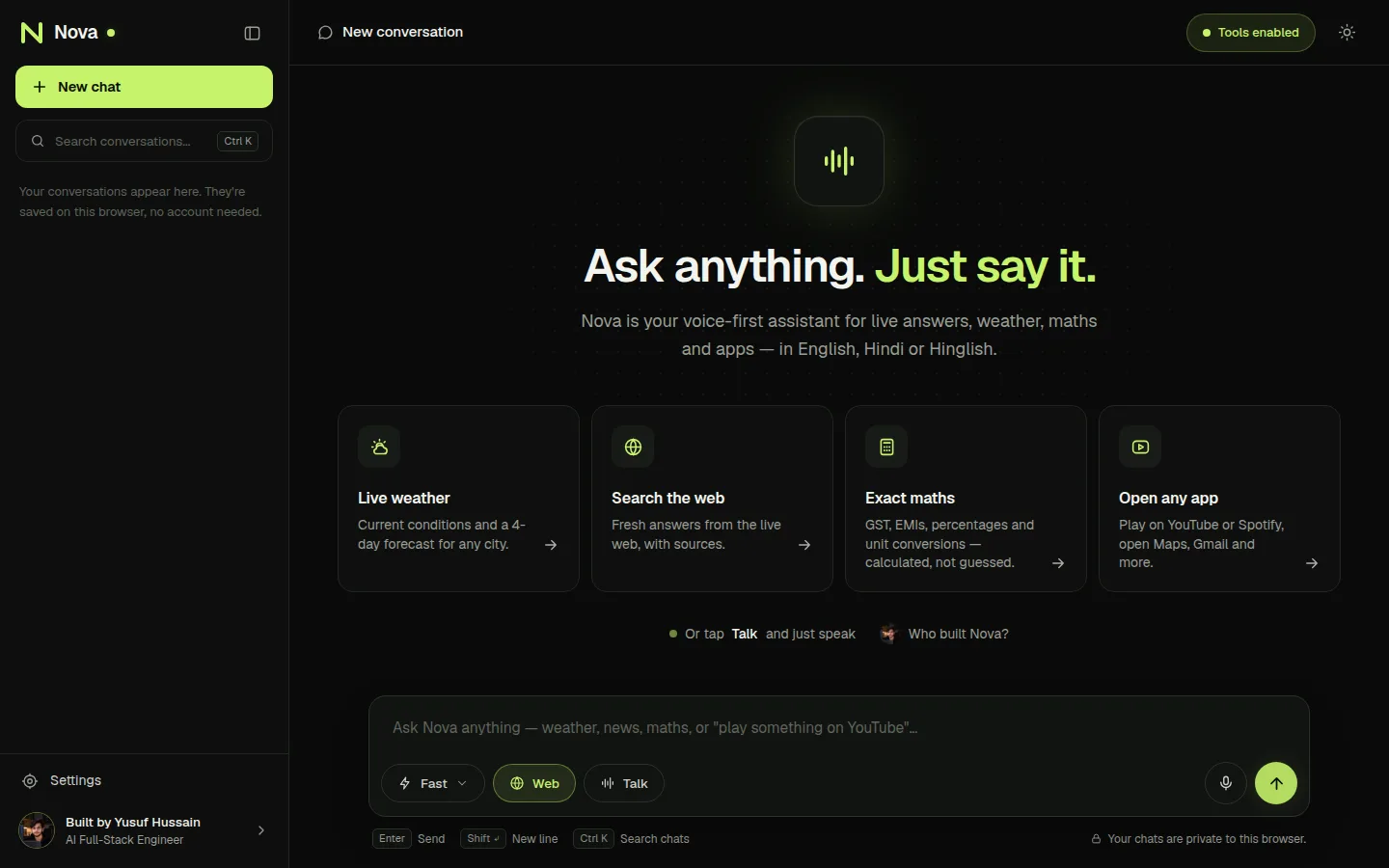
A voice-first AI assistant that searches the web, checks the weather, does exact maths and answers out loud.
- languages: English, Hindi, Hinglish
- 3languages: English, Hindi, Hinglish
- sign-ups needed to start talking
- 0sign-ups needed to start talking
- AI providers, with automatic fallback
- 2AI providers, with automatic fallback
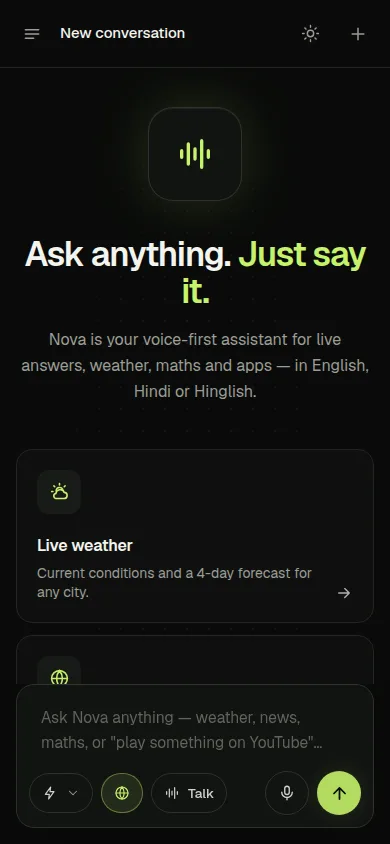
Talk to it or type. Nova uses real tools instead of guessing: live web search with sources, a weather card with a 4-day forecast, exact maths and unit conversion, and actions like “play lo-fi on YouTube”. It replies in English, Hindi or Hinglish, and needs no sign-up.
OriginNova 2.0 is a ground-up rebuild of my 2025 AI Voice Assistant (React, Express, MongoDB, Gemini).
My first voice assistant could talk, but it guessed. Ask it the weather or a GST calculation and you got a confident sentence, not a fact. I wanted an assistant that reaches for a real tool whenever a real answer exists, and that you can use hands-free like a person in the room.
- Q1
How do I stop a language model from guessing numbers, weather and news?
- Q2
How can voice feel natural, with no button between every turn?
- Q3
How do I keep chat history private without forcing people to sign up?
- Q4
A public AI demo costs money per message. How do I keep it from being abused?
- StackBeforeReact + Express + MongoDBAfterNext.js 16 (App Router, Cache Components), Neon Postgres + Drizzle, deployed on Vercel
- AIBeforeGemini classifying intent from a promptAfterAI SDK 7 tool calling: web search, weather, mathjs and app actions; OpenAI primary with Gemini fallback
- VoiceBeforeBrowser speech APIs, a button for every turnAfterHands-free mode: end-of-speech detected from the mic level, tap the orb to interrupt; OpenAI transcription and speech
- HistoryBeforeNeeded an accountAfterAnonymous HttpOnly session cookie scopes every chat to one browser; one click wipes it
Tools, not guesses
Web search with sources, Open-Meteo weather, mathjs for exact maths and unit conversion. The model decides which tool to call; the tool produces the answer.
Detect end of speech from the mic level
Web Audio measures the level, so you just speak and pause. Voice turns use minimal reasoning effort and a spoken-style prompt (short, no markdown) to keep latency low.
An anonymous session instead of accounts
An HttpOnly cookie scopes every chat and setting to one browser. Every read, write and delete is checked against that visitor id; anyone else gets a not-found page.
Fallbacks everywhere
OpenAI is primary with automatic Gemini fallback; weather falls back from Open-Meteo to wttr.in. A demo that breaks when one vendor hiccups isn't a product.
- Hands-free voice mode: speak, pause, and it answers aloud
- Interrupt any time by tapping the orb
- English, Hindi or Hinglish, spoken and written
- Live web search with sources
- Weather card with a 4-day forecast
- Exact maths, GST, EMIs and unit conversion
- App actions: play on YouTube or Spotify, open Maps or Gmail
- Chat history without accounts
- Search conversations with Ctrl K
- “Clear history & reset” wipes everything
Per-visitor hourly caps on chat (40), transcription and speech (80), a 4,000-character message limit and an 8 MB audio limit. Resetting history doesn't reset the caps.
Every chat read, write and delete is checked against the visitor id from the HttpOnly cookie.
History lives on the server and is validated against tool schemas before each streamed reply is saved.
Hosted on Vercel in Singapore, next to the Neon database, with the HTTP driver so there is no server to run.
Making streaming and persistence agree. The client sends only the new message; the server loads history from Postgres, validates it against the tool schemas, streams the reply and saves it when it finishes. Regenerate trims history on the server, not in the browser.
The model is the easy part. Cost caps, isolation between visitors and fallbacks are what turn a demo into something you can leave running on a public URL.