Body Tracker
In-browser face, hand, and pose tracking that turns a webcam into live posture and attention scores.
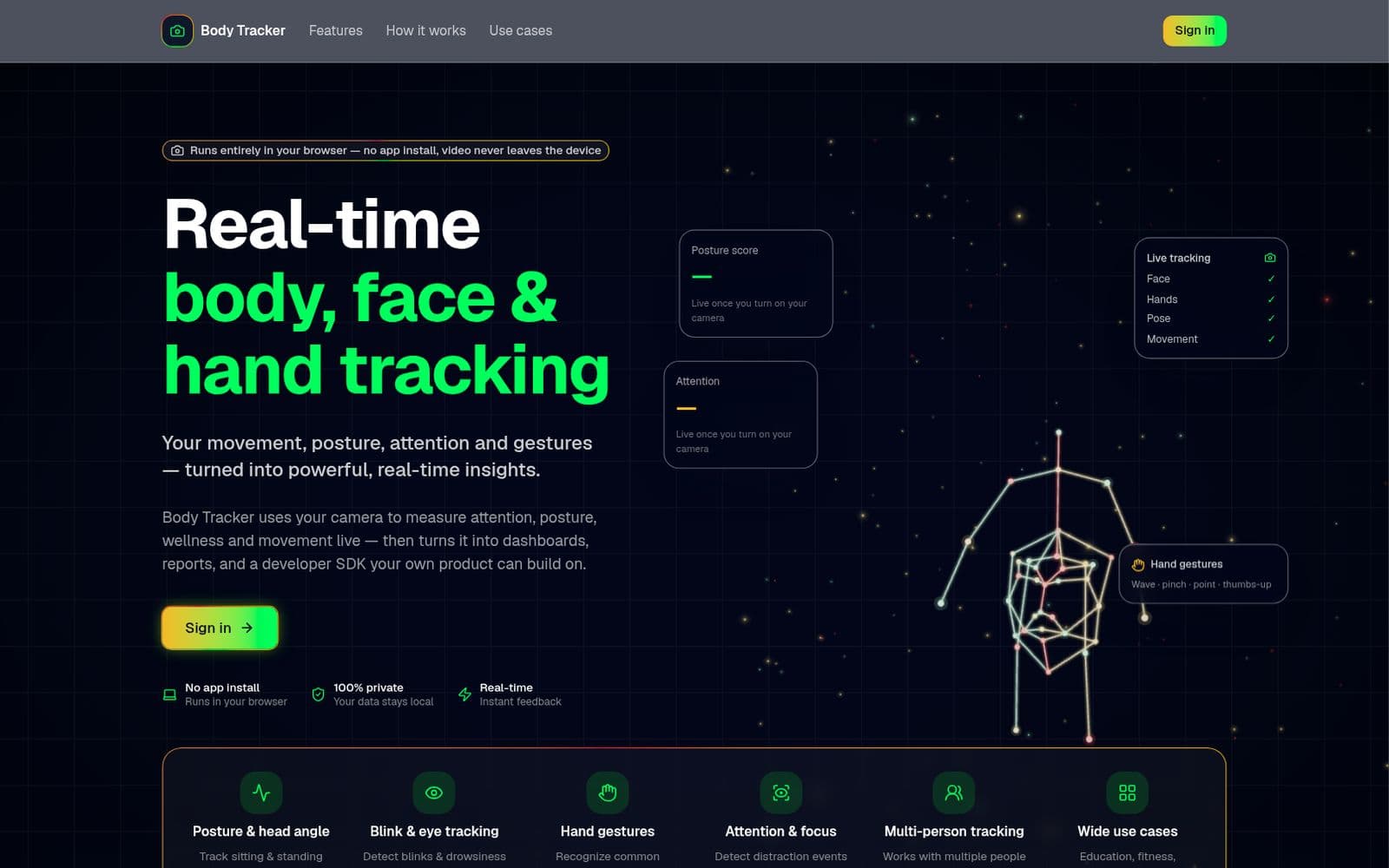
Measuring how someone sits, moves, or focuses usually meant wearables, dedicated sensors, or uploading video to someone else's server.
Measuring posture or focus usually means wearables, dedicated sensors, or uploading someone's camera feed to a server. A webcam and a browser should be enough.
- Q1
Can face, hand and pose models run fast enough inside a browser?
- Q2
How do we keep video private by design, not by promise?
- Q3
How can other products reuse the same pipeline?
MediaPipe face, hand, and pose models run inside the browser, scoring the camera feed live and exposing the same pipeline as an SDK.
MediaPipe on the device
Face, hand and pose models run in the browser, so the camera feed never leaves the device.
Scores, not raw landmarks
Tracking data becomes posture, attention and fatigue scores people can understand — plus session PDF reports.
Ship it as an SDK
A JavaScript SDK and React hooks expose the same pipeline to other products.
- 01Webcam
- 02MediaPipe in browser
- 03Posture · attention · fatigue
- 04Dashboard · PDF · SDK
Turning noisy, frame-by-frame landmarks into steady, meaningful scores in real time, on ordinary hardware.
Privacy can be an architecture decision. If the video never leaves the device, there's nothing on a server to protect.